- Accueil
- Prestations
- Technologies
- Portfolio
- Formations
- Blog
- CONTACTS
- Retrouvez nous sur

The 4 risks of a RETROFIT in Machine Automation
Let's explore the 4 risks of a RETROFIT in Machine Automation
Introduction
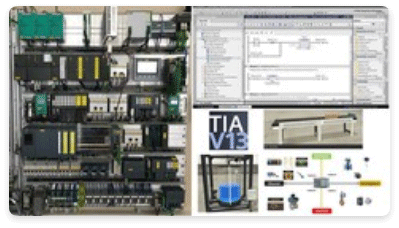
They are four occasions when it's a bad idea to do a retrofit and that's what we'll discuss now. We will discuss today a little bit about machine automation. We are back to the hardware world today, I want to take one example to give you an idea about the risks that sometimes we take by accepting or trying to do a retrofit. Sometimes it can go very bad and this is why. We are going to take one example, a machine that our company had to retrofit in 2022. If we go on that link 2022 retrofit counter-example you can view a little summary of the machine that's I'm talking about. I take this example because it's a pretty good example to show you why we can sometimes take a lot of risks when we are accepting to do a retrofit. So, why it is a risk sometimes to make a retrofit ? Let see the differents risks.
Risk 1 - The Platform Gap
The fact of Switching brands (Schneider to Siemens) is a major risk compared to sticking with the same manufacturer. Moving a program from one brand (e.g., Schneider) to another (e.g., Siemens) is not a simple "copy-paste" and involves fundamental architectural changes.
The best practice is to stay on the same platform to minimize conversion errors.
Explore the full content of this section here
Risk 2 - The 50/50 Debugging Rule
Debugging time is almost always underestimated. It should be budgeted as equal to the total programming time (1:1 ratio).
Debugging time should equal programming time. You must allocate as much time for debugging as you do for actual programming. Underestimating this leads to "infinite" project timelines.
Explore the full content of this section here
Risk 3 - Programming "Frankenstein"
Retrofitting code that mixes multiple languages (like Graphset and Ladder) without a clean structure often makes a rewrite from scratch more efficient than a conversion.
Avoid retrofitting code that lacks a clean methodology or mixes too many languages, as it’s often faster to rewrite it from scratch.
Explore the full content of this section here
Risk 4 - The Documentation "Hard No"
Without electrical diagrams and a functional description of the machine's behavior, a retrofit should be rejected as it will inevitably spiral into a new, undocumented project.
Without these two factors, a retrofit is essentially a "blind" project and should be rejected.
Explore the full content of this section here